
Strong negotiations are built long before anyone sits down at the table. They begin in the contract creation process from the structure, the clarity, the organization, and the way the legal team prepares. After a decade of leading negotiations as a General Counsel, I’ve learned that the contract itself can accelerate a deal or drag it out. The best negotiators argue well and prepare well.
As you may have seen on my LinkedIn, I am a strong advocate for breaking anything down step by step, utilizing conversational, practical examples. I do the same thing in both my books, CCS and The Contract Checklist, because I think it’s the easier way to learn and retain information. And so, here are my very real, tried and true practical tips for creating stronger contracts, shaping better negotiations, and using a Contract Lifecycle Management (CLM) system like LinkSquares to give your legal team a measurable advantage.
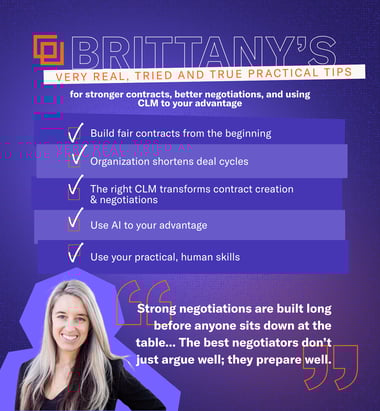
1.) Build fair contracts from the beginning
You’ve been there: you get a contract from the other side and think, “Do they really think I’m going to agree to all of this one-sided garbage?” One-sided indemnity, outlandish limitation of liability, IP ownership (nice try!), I know you’ve seen it and so much more. Similarly, how refreshing is it to get that rare diamond where you make minimal redlines and think to yourself, “I need to add some of this to our own template!” A well-drafted template is your single most powerful lever for speeding up negotiations.
A fair template consists of closed loopholes (don’t try to leave in first-party indemnity claims to double dip after you’ve reached the maximum limitation of liability), remove vague phrasing, and add detail where business teams commonly ask questions. Every time someone must jump to Section 14(c) just to understand Section 3(a), friction increases. Clean drafting makes every conversation easier. You aren’t aiming for perfect, but you are aiming for predictable and repeatable. You want the relationship with the other side to start off on a good foot, especially if it’s a long-term deal.
If you make the templates unfair and you are just hard to deal with in negotiations, you are setting yourself up for a hard road ahead. If an issue arises on your side, after you were a clown during negotiations, how nice do you think the other side is really going to be? So often, when I have a good negotiation with the other side in the beginning, and an issue arises, I am more than willing to be more accommodating and work out the problem instead of looking for every single recourse to punish them in the contract.
Front-load your business terms and make the contract easy-to-understand for everyone. Put the items people care most about early in the agreement: term, pricing, scope, SLAs. If the big rocks are buried on page nine, you’re forcing both sides to hunt for clarity. If your sales team, vendor, or CEO can’t read the contract without translating legalese, you’re guaranteeing delays. Simplicity builds trust and speeds up signatures.
Lastly, a strong fallback library gives your negotiators confidence and prevents stall-outs, including:
- Alternative indemnity caps
- Different limitation of liability structures
- Options for renewal terms
- Multiple governing law selections
- Payment term variations
When your negotiators know what they can give, and what they can’t, deals move faster.
2.) Organization shortens deal cycles
If you want speed, consistency, and leverage, you must know:
- What’s in your contracts
- What’s been negotiated historically
- What positions were approved and why
- Where risk is concentrated
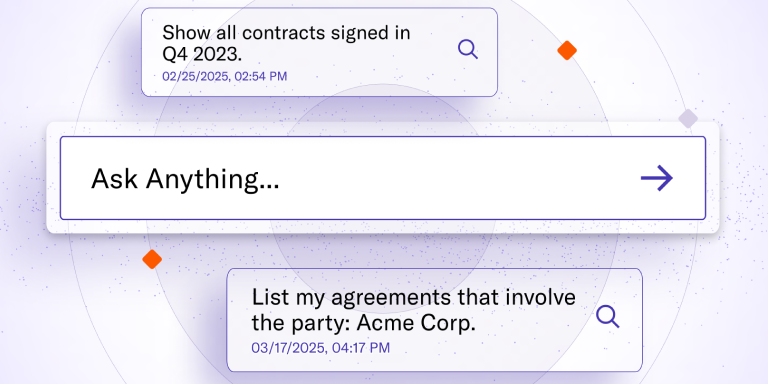
Some teams struggle not because they draft poorly, but because they negotiate in a vacuum. Maintain a clear threshold matrix for risk decisions and standardize redline responses for common asks so teams stay aligned where tools like LinkSquares Risk Scoring Agent can help. Organize fallback clauses by risk level and build a simple “who approves what” flow to eliminate bottlenecks. Create a one-page cheat sheet for Sales outlining what is and isn’t negotiable to keep deals moving quickly. Preparation removes emotion from negotiations and lets you show up with clarity and confidence.
.png?width=502&height=282&name=1920x1080%20(3).png)
3.) The right CLM transforms contract creation & negotiations
The right CLM transforms negotiation by giving your team full visibility into every clause variant across your executed agreements. You can track whether you have agreed to a specific term before, which fallback was used last time, and what your true standard language looks like in practice. This level of insight eliminates internal debates, reduces research time, and ensures a consistent, confident negotiation posture.
A modern CLM also accelerates internal approvals by removing email chains, lost drafts, and unclear ownership. When everyone knows exactly where a contract sits in the process and who needs to act next, deals naturally move faster. The system also gives you real leverage at the negotiation table because you walk in with data on renewal dates, prior concessions, customer history, and risk patterns. Instead of guessing, you negotiate with real intelligence.
Finally, a CLM becomes the foundation of organizational scale. With templates, clause libraries, playbooks, and analytics stored in one place, new team members ramp quickly, stay aligned, and negotiate with confidence from day one.
4.) Use AI to your advantage
AI is crucial to modern negotiation preparation because it helps teams work faster and more strategically. It allows legal departments to refine drafts, spot risks, and anticipate pushback long before anyone gets to the negotiation table. For drafting, AI can quickly improve clarity, identify issues, and generate alternatives that fit different negotiation scenarios:
Here are a few of my favorite prompts for drafting:
- “Rewrite this clause for clarity at a 10th grade reading level.”
- “Identify ambiguities or risks in this indemnification section.”
- “Provide three alternative versions of this clause”
- “Summarize this contract in five bullet points focused on business risk.”
AI is just as valuable for analyzing what may come next in negotiations.
Prompts for negotiation analysis:
- “List the five most likely pushbacks we will receive on this draft and suggest responses.”
- “Highlight any clauses where our position is materially different from industry norms.”
And when you are preparing for a negotiation, AI helps you organize your strategy and eliminate uncertainty.
Prompts for preparation:
- “Create a negotiation plan outlining priorities, fallback positions, and deal breakers.”
AI doesn’t replace lawyers, but it does replace hours of manual prep, so you can focus on strategy, persuasion, and better outcomes.
.png?width=502&height=282&name=1920x1080%20(5).png)
5.) Use your practical, human skills
No tool can replace the real skills you’ve earned on the job. Here are my winning negotiation tips:
- Give yourself permission to not respond immediately.
- My subtle negotiation trick: wait 17 seconds before responding to a tough question or aggressive ask. I’ll never forget the time my professor in my 3L negotiation class came in and sat down, and stared at us for what felt like an eternity. He was older, so we immediately thought something was medically wrong and retrieved our phones to call 911. I remember him saying, “Leonard! Put that phone away, what I’m trying to teach today, just proved my point. People hate silence, so they’ll do more and say more than necessary and it will help you leverage the deal.” It signals confidence, resets the emotional tone, and prevents reactive concessions.
- My subtle negotiation trick: wait 17 seconds before responding to a tough question or aggressive ask. I’ll never forget the time my professor in my 3L negotiation class came in and sat down, and stared at us for what felt like an eternity. He was older, so we immediately thought something was medically wrong and retrieved our phones to call 911. I remember him saying, “Leonard! Put that phone away, what I’m trying to teach today, just proved my point. People hate silence, so they’ll do more and say more than necessary and it will help you leverage the deal.” It signals confidence, resets the emotional tone, and prevents reactive concessions.
- Ask clarifying questions before pushing back.
- Instead of responding with a no, try asking, “Can you share why this is important on your side?” Most unreasonable asks soften once you understand the underlying fear or pressure.
- Instead of responding with a no, try asking, “Can you share why this is important on your side?” Most unreasonable asks soften once you understand the underlying fear or pressure.
- Separate the people from the position.
- Great negotiators focus on the issue, not the emotion. Keep the conversation centered on shared goals rather than personalities.
- Great negotiators focus on the issue, not the emotion. Keep the conversation centered on shared goals rather than personalities.
- Use “positive framing” when delivering hard answers.
- For example, say “Here’s what we can offer that still protects both teams,” instead of, “We can’t agree to that.”
- For example, say “Here’s what we can offer that still protects both teams,” instead of, “We can’t agree to that.”
- Move the conversation back to alignment frequently.
- Use reminders like “Let’s remember the outcome both sides want…” to keep discussions from spiraling into minor issues.
6.) Bringing it all together
Stronger contracts create smoother negotiations. A well-organized template library, clear fallbacks, and a confident negotiation strategy all contribute, and the right CLM turns these best practices from ideas into repeatable, scalable reality.
When you pair:
- strong drafting
- a clean organizational structure
- smart negotiation habits
- a CLM that gives you visibility and data
…you shorten deal cycles, reduce risk, and give your legal team the leverage it needs to support the business with speed and confidence. If your goal is easier, faster, better negotiations, the work doesn’t start at the negotiating table. It starts in how your contracts are built, managed, tracked, and learned from, and CLM is the infrastructure that makes that possible.
Ready to Learn More About LinkSquares?
Watch our on-demand demo to learn how our CLM platform can help your team avoid unforeseen fire drills when it comes to contract management. Then schedule a custom demo here.
.jpg?width=290&name=BrittanyHeadshots%20(1).jpg)